Showing posts with label Greek Tragedy. Show all posts

Wednesday, 8 June 2011

The Book Lover's Tale by Ivo Stourton: Review


Stourton: nimble
Ivo Stourton's second novel, The Book Lover's Tale, is a deliciously dark literary thriller that concerns the seamy habits of an interior decorator, Matt de Voy. de Voy once had ambitions to be a writer; after his first novel was published, he found himself becoming increasingly dependent on his aristocratic girlfriend; eventually abandoning all pretence of 'writing', he ended as second in command to his now-wife's interior decorating business, where his job is to be the arbiter of elegance (sort of like Petronius, except madder) and sneer at the wide-boys who come to him for assistance whilst fornicating fulsomely with their wives. It sounds like the best job in the world. de Voy is a splendidly conceived character, possessed of a self-belief that precludes any sort of reflection that isn't directly focussed upon himself. He is vain, snobbish; he believes that he inhabits some kind of Les Liaisons Dangereuses world where he can seduce people by giving them books (in particular Anais Nin); he is mean to his long-suffering wife and to his lovers; he also believes that he can bring back the simplicity of Greek tragedy to the long-corrupt, amoral English landscape, where the old guard has fled to the back streets of Chelsea, its values and standards imitated by barrow boys and foreigners (as de Voy sees it). In this world soldiers are sneered at by bankers; sex is a weapon, and everybody has ulterior motives. It's bleak, brittle, and fascinating.

de Voy falls in love - or rather, obsession - with one of his client's wives, and resolves to keep her for himself. This can only be done, he decides, by murder. The novel hurtles along keenly to its resolution, giving us a portrait of a man of extremes as he battles his way through the inconsequential nothings of London society, threatening to make a final statement that will have real, destructive power - much more power than he could ever achieve through the subtle arrangement of books in a banker's palace.

Stourton has a gift for the vivid and the violent: there are many bold, striking scenes, as when a guest falls from a balcony at a party, or when one of the characters suffers a terrible accident. The reader marvels at de Voy's audacity and self-deceiving arrogance, and yet is pushed along by a plot that is hooked and shining - with some elegant literary criticism along the way. Stourton's smoothly shocking novel is a sharp comment on our heavily consumerist lives: de Voy, after all, is only a product of the system - just one that's taken things a little too far.


Monday, 17 January 2011

My Son, My Son, What Have Ye Done: review


A man wielding a samurai sword talks to his hick uncle about giant chickens whilst a dwarf stands mutely in the background on top of a giant hewn tree stump: yes, it's what we've all been waiting for - Philip's dream diary! Actually, no, come back - it's what we really have all been waiting for - a collaboration between oneiric aeronauts Werner Herzog and David Lynch. When I heard about this film (from one of those snazzy little New Yorker reviews that make you realise why you shell out five quid for it every now and again) I stuck the review to my board and waited and waited... I got the DVD for Christmas, and watched it last night.

On one level, it is supposedly a true story, about a young man who goes insane and kills his mother in front of their neighbours. On another, it is a retelling of Aeschylus' Oresteia. This is the level I was most interested in (although it would be fascinating to read details of the case). There was no suggestion of a skeleton in the family closet: Brad (played with astonishing, almost automaton-like power by Michael Shannon) was a strange man who lived with his mother in a house inhabited (and decorated) by flamingos. It was his closeness to his mother that provided the necessary motive, (rather than Clytemnestra's killing of Agamemnon.) She was ably played by Grace Zabriskie as a neurotic, gurning control-freak who swanned around in padded dressing gowns and twisted her hands a lot. She reminded me, in fact, of a detail from a performance of the Oresteia I saw about eleven years ago, when a camera was used to focus in on Clytemnestra's twisting hands as she talked to the audience. Brad, perhaps escaping his mother, perhaps seeking something else, goes to Peru with some friends; when they all die, drowned in white water rapids, except him, he believes he has been saved by an 'inner voice'. He starts to obey this voice, which causes him to change his life drastically.

The action takes place from the finding of the body of Brad's mother; a siege of Brad's house begins; it ends with his arrest (unity of time and place). There are suitable flashbacks as narrated by the two people closest to Brad (apart from mummy dearest, of course): his girlfriend (acted with gamine charm by the doe-like Chloe Sevigny), and a theatre director (Udo Kier looking and speaking with a high degree of European camposity.) Willem Defoe plays the (extremely polite) policeman. The diction is often quite high - the title of the film comes from the last words Brad's mother says to him as he kills her.

Brad has taken the lead role in a production of the Oresteia: its themes and resonances begin to obsess him deeply. They fit in with his own increasingly skewed view of the world, in which he must 'razzle them. Dazzle them.' His hallucinations lead him to see God in a can of oatmeal; his uncle provides a disturbingly vivid vision of the apocalpyse (which, despite it concerning giant chickens, is oddly effective. Hence the dwarf and the stump. You'll just have to watch it.)

When the SWAT team swarms over Brad's bright pink house it's as if the Furies have descended upon the house of Atreus - that house, bathed in blood from Tantalus to Orestes, generation after generation of cannibals, killers. (Incidentally, I've often wondered what it would be like to sit in on a gathering of the Atreidae. 'So, Electra, been up to much recently?' 'Well, after Orestes and I killed mum, we thought we'd go and visit our supposedly dead sister - it turned out after all that daddy hadn't killed her, instead Artemis - thank the gods - had substituted a deer! Fancy a chop? I hope that grandfather hasn't gone wild again... talking of which, anyone seen Pelops?')

Whereas the end of Aeschylus' play suppresses the terrible wild justice of the Erinyes, and replaces it with the formal justice of Athena, here there was ambiguity. Would Brad's insanity play a factor? A final image, of a basketball left by Brad in a tree in the hope that a boy would find it, provides a haunting sense of tantalising (ha!) redemption - but compromised. When a boy does pick up the ball, is he merely carrying on the cycle, or is he ending it?

All in all, a psychotically interesting brew, scored with jazz and cellos blazing, and with sudden static moments underscoring the action that are striking when they happen and gain a new layer of meaning at the end. A loopy delight. Now, back to those chickens...

My Son, My Son, What Have Ye Done? [DVD] [2009]

Wednesday, 22 December 2010

The Apprentice as Greek Tragedy


The Apprentice as Tragedy

A fearsome presence descends from the heavens, attended by two hovering Furies clashing their teeth, ready to dispense justice upon the mortals quivering below. An unearthly light permeates the air: the scene is metaphorically dripping with blood. It is, as Cassandra says when she arrives at the house of Atreus in Aeschylus’ Agamemnon, ‘a human slaughterhouse’; a body has just been displayed to the baying audience, whilst the other characters have been through a test of psychological and physical endurance. Yet one person will be saved; one who has performed correctly; one person to make some sort of order out of the chaos left behind by a glut of misunderstandings and errors. You might be forgiven for thinking that I’m describing the end of a Greek tragedy. I am – up to a point. In fact, it’s The Apprentice, with Lord Sugar as the deus ex machina, and Karen and Nick as the crime-pursuing Furies.


Yes, it’s the closest thing we have today that both follows the same arc and has the same effect as a traditional Attic tragedy. An audience of Athenians, settling in at the City Dionysia (a festival of plays and other events), would have known exactly what to expect from what was put in front of them. When it came to tragedies, they were in for a bout of kin-killing, incest, or another sort of god-defying behaviour; the point being, according to Aristotle, that having watched the antics of a Pentheus (torn apart by his own mother) or an Agamemnon (slain by his wife), afterwards they would be ‘purged’ of pity and fear, and thus be able to live happily.


So it is with The Apprentice. Like the City Dionysia, it brings the country together in voyeuristic pleasure – what Mrs Radcliffe called ‘the strange delights of artificial grief’. We settle down in front of the television, and as ‘Montagues and Capulets’ kicks in, our brains spark with the knowledge of what we are about to receive. We are gripped by the consistency of the narrative, with all its dramatic ironies and reversals of fortune, just as the Attic audiences were. The formal nature of the program feeds our synapses in exactly the same way. Aristotle posited that a tragedy has unities of time and space. The tasks in The Apprentice take place over 24 hours. The house and the boardroom function as fixed loci, with the beautiful London townhouse standing in for the ancient palaces of the nobility (the skene, from which characters emerged to meet their fates); and the contestants’ tasks do tend to be confined to a certain place, such as a shopping centre.


Greek tragedy concerned the misbehaviour of people in an elevated position – kings, queens and heroes. In our meritocratic society, what more elevated position could there be than someone in Lord Sugar’s ambit? Fighting for position in an ‘agon’ (contest), just as the actors in the Dionysia contested to win a prize, these are Brtain’s ‘brightest business hopes’. And, in the same way as Pentheus refuses to believe in Bacchus, or Agamemnon walks upon the purple cloth, thus showing his pride, the contestants yap and bark about their brilliance at various different skills (well, mostly selling.). They’re riding for a fall. They have committed hubris – an assault on the gods.

Of course the real tragedy in all this is that the prize of the one who’s saved is a job with Lord Sugar. This, to my mind, makes The Apprentice a far more effective tragedy than even the Agamemnon. That cycle came to an end with the Furies tamed; we know, however, that The Apprentice could go on for ever. And that is what makes it so brilliantly tragic: with no limit, it reflects the endless vicissitudes of human existence. So let us pour libations to Lord Sugar (anax glukus?) and joyously acclaim the next series.

(Incidentally, Chris Bates should have won. Anax Glukus seems always to be swayed by where people come from. Is that prejudice? I think so.)

Sunday, 5 December 2010

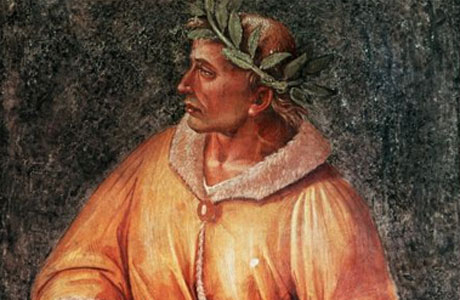
Ovid and Sophocles: They've Done it Again


The weekend was spent buried deep in various texts, for various reasons; as I truffled through them I did come up with this:

'saepe pater dixit: 'studium quid inutile temptas?
Maeonides nullas ipse reliquit opes.'

Plus ça change
. It's from Ovid, Tristia (4.10), and its translation is as follows:

'Often my father said, 'Why are you hacking away at that pointless fad?
Homer himself didn't leave behind any money.'


It's Ovid's father, telling him off for wanting to be a poet. Ovid's brother, of course, is a sparky lawyer. (Maeonides is a name often used for Homer as he was thought to have been a native of Maeonia, or Lydia as it was otherwise called.)

It is so marvellous to hear the voice of the father roaring out across the centuries as his useless son potters about with ink and papyrus instead of swotting up on legal precedents. More proof, if any is needed, of the 'relevance' of classical studies...

Also, what could be more beautiful than this, from Sophocles' Ajax?

'horo gar hemas ouden ontas allo plen
eidol' hosoiper zomen he kouphen skian'

Translated (poetically, in the Penguin translation) as

'Are we not all,
All living things, mere phantoms, shadows of nothing?'

Tuesday, 9 March 2010

Euripides Fragment 25

Stumbled across this fragment of Euripides:

pheu! pheu, palaios ainos hos kalos echei;
gerontes ouden esmen allo plen psophos
kai schem', oneiron d'herpomen mimemata,
vous d'ouk enestin, oiomestha d'eu phronein.

Translation:

Alas, alas, how the old tale holds truth;
we old men are nothing but noise
and appearance; we creep along, imitations of dreams,
there is nothing in our minds, though we think that we are sane.

Beautiful and sombre and quite heartbreaking.