Showing posts with label william shakespeare. Show all posts

Wednesday, 24 September 2025

September Round Up


It's been a busy September, as autumn appears and a chill enters the air. 

I had a piece in the Spectator Schools supplement, here, on my boarding school memories, and another piece, about going to Lancing and Dorset House, which came out in the Lancing College magazine, Quad.

My Substack has been trundling along, with pieces on Ivy Compton-Burnett, Ovid's Tristia, the economics of writing books, John Lowin (an actor and contemporary of William Shakespeare), and the children's author Susan Price, whom I have recently discovered, having reviewed a reissue of her wonderful The Ghost Drum.


Friday, 29 August 2025

Summer Posts

 It's been a busy August, what with the "holidays", and trying to work alongside them... here are a few posts and articles that I've managed to produce over the past few weeks. 

Notes on Flatmates for the Spectator, about the new Pope's living arrangements.  

A piece about Letters of Introduction, also for The Spectator.  

And continuing my series about Shakespeare in Context, a piece about the Burbages for my Substack


Saturday, 17 May 2025

A Writer's Diary: Ten Years Later


A Writer’s Diary. Part Two, May 2025

By Philip Womack

Ten years ago, I wrote a blogpost about my daily life as a writer. A few weeks ago, it suddenly rocketed to the top of the most-read list on this blog; I sent it to my current  writing students, who enjoyed it; and so I decided to do another one. Writers are often supposed to live quiet, monastic lives: to which my response is: if only.

The major difference, in writing terms, in the decade between now and then, is that I came to the end of a contract last year, so I’m now writing on spec. 

This has  benefits and  drawbacks. The benefits are that there is no immediate pressure; the downside is that, for this very reason, the writing  tends to be pushed to the sides.

Domestic life also plays much more of a part than it did ten years ago: children must be nourished, driven about, collected; dogs must be walked; et cetera. 


Monday 12th May 2025

My day begins at 6am, and I lurch to my laptop intending to look at my new children's novel. I am instead distracted by the online Shakespeare wars. Some time ago, I wrote an article about the ridiculous theory that Emilia Bassano was the “real” writer of Shakespeare’s plays; and ever since then I’ve found myself fascinated by the world of Shakespeare deniers.

Most of them are harmless. They show themselves up, denying and distorting all facts in order to prove their idees fixes. I’ve even heard one of them say that the Earl of Oxford came back from the dead to write Pericles. Which rather makes you wonder why he didn't do a better job. One favourite tactic of theirs is to claim that Shakespeare didn’t go to the Stratford Grammar School, because there are no records of him attending.

The fact is, that we don’t have any records from the Grammar School in Stratford at all, until 1700; and yet there was a school there, and Stratford upon Avon produced some very fine and learned men. One of these was Shakespeare’s first publisher, Richard Field, his direct contemporary.  Field's life is a great analogue to Shakespeare's. Suggest this to the deniers, and they will say that Field didn’t go to the grammar school either, and that he only needed a rudimentary education to become a printer.

We do have records of teachers at the school being paid, including one who was a Latin poet; this leads the deniers to claim that the teachers were not teaching, and the school was  in fact empty. Their persistence leads them into untenable positions. Some of the deniers are very inventive; and I do often wonder why those talents can’t be used in a different manner.

So why continue to involve myself? Four reasons: one, it reminds me of how much I love Shakespeare, and often I’ll return to his works; two, it can lead to some very surprising and interesting discoveries amongst the minutiae of Elizabethan and Jacobean literature; and three, I find it both stimulating and amusing. But perhaps the most important is the fourth: I believe in fighting falsehood with truth. 

Back to real life: having dropped off the various children at their various schools, and having chatted to the eldest’s history teacher about St Edmund the Martyr, I rush home to wait for the piano tuner, beginning writing at 9am on the dot. He does not appear, and so I continue to write until 10am, by which point I have placed my protagonist into a situation so impossible that I have no idea how I’m going to get him out of it. A common theme with me.

At 10am, I switch to editorial work. This is bread-and-butter stuff; the bill-paying aspect of the business. The piano-tuner comes, and I continue with the editorial work (with breaks for lunch and errands) till 2pm, when I practise the piano for half an hour. I’ve been learning Ravel’s Ondine for over a year now: a shimmering, impossible piece; music and writing are so clearly interlinked, and one day I hope to write about it. For the moment, though, I simply enjoy its ravishing effects.

In the early afternoon, I read for the Literary Review children’s round up which I produce three times a year. Again, I do this for many reasons: it keeps me abreast of the children’s book world; and I also aim to give children’s books a serious place in the annals of criticism.

At 330pm, it’s out to fetch the offspring. Traffic, and a quick visit to the bookshop, mean that I’m not back home till 445pm. I have approximately an hour in which to work. I begin to look again at what I wrote this morning, but a storm breaks. In my study, the atmosphere feels electric; it’s not long before hail is pounding the rooflight. At one point, it looks like the River Nile is flowing down our street.

Fortunately, it abates, and then I head off to the Stationers’ Hall on a crammed rush hour tube train, where somebody taps me on the shoulder, mistaking me for a friend of his called Harry. I assure him I am not Harry. He shows me a picture. We are not very alike. He says he’s not wearing his glasses.

I’ve been on the Livery at the Stationers for a while. Tonight’s event is a lecture on Henry Purcell, given by Sir Nicholas Kenyon, who was Controller of Radio 3. It’s a fascinating talk, with gorgeous performances by a tenor and a theorbist: close your eyes, and you could, just about, imagine you were at the wedding of Queen Anne and Prince George of Denmark.

There are drinks and sandwiches afterwards, and I gossip with an ex-Tatler staffer and an antiquarian bookseller (who has a folio of Two Noble Kinsmen), before heading home.

Tuesday 13th May

A later start than yesterday; I spend about fifteen minutes looking for the dog’s lead before heading out for the drop offs and dog walk. It’s 845am before I settle down at my desk, and I must undertake a bit of admin, before writing for an hour. I have, essentially, reached the end of the narrative, but it all feels very bare bones, and I know I’m going to have to spend a long time sorting it all out. However, it is a milestone, and I feel pleased with it.

The rest of the day follows much the same pattern as yesterday: editorial work, piano practice, and reading for the round up. I also spend some time with the newspapers, which I do every day: partly to keep informed, but also, if I see something interesting, I can pitch an article or review off the back of it. A couple of things look promising, so I note them down.

In the evening, I take the eldest to cricket, and read whilst he’s playing: Park Honan’s biography of Christopher Marlowe, a rich and fascinating study of this elusive playwright. This, too, is research: all reading is. You never know.


Wednesday 14th May

Up at 5am. Domestic chores, then I read over what I wrote yesterday with the agonising clarity of dawn (it’s rubbish, it’ll never work, etc etc.), and then jump into the car to drive to rural Kent, and a school where I’m leading a writing workshop.

It’s a huge school, with over 1,000 pupils. The sun is shining, the green fields are lush; the sixth formers I’m teaching are keen, quiet and polite, and, despite some initial fluster with photocopying, the workshop runs smoothly. Most writers will have some kind of educational string to their bows: I enjoy it, not least that I see swathes of the country that I otherwise never would, but also to meet and talk to young people. Although none of them have ever heard of Joseph Conrad, I can say with confidence that all is not lost.

I reach home in the early afternoon, and write my report of the day for the workshop organiser; then I read for the round up for half an hour before pick up time. I have, however,  forgotten that the eldest is in a debating competition; so having chatted idly to the history teacher for ten minutes before wondering where he was, I return home via the other school, scooping up the rest of the family (including the dog, who’s been in the office with my wife today).

At home, though I manage a bit more reading, work effectively ends for the day, and later (having, of course, retrieved the eldest), we relax with Jonathan Creek. Preposterous plots, but wonderful characters.

Thursday 15th May

The day is overcast and gloomy, but it does begin at a more usual time. I manage a bit of research between 610 and 630am; then musical instruments are located; bags packed; schedules checked; and the children dispersed.

I have a meeting at 10am at the Stationers Hall; I want to retrieve information about Richard Field. I spend an hour looking through Liber B, which holds the Stationers’ records. It is an experience both quasi-mystical and entirely pragmatic. I tend to wax lyrical about the handwriting on the page: the quill held by a real person, several hundred years ago, writing down details of Shakespeare’s publications, Spenser’s, Sidney’s, and all the rest of them. I find what I want, plus more information about apprentices at the time, and return home to type it up for a Substack post. I’ve recently joined Substack, and it’s a platform I find more congenial than most.

At 230pm, a commission comes in from The Spectator; the deadline is tomorrow. So I drop everything to draft a piece, which I work on till pick-up time.

In the evening, (with offspring having been read to and put to bed, etc) I continue on the piece until about half past eight when the old eyes begin to droop, and I hear the siren call of the sofa.

Feelling a little sad that I haven’t been able to look at my novel for two days, I remind myself that I’ve gained much useful information today; I’ve received a commission; and I’ve also been discussing a new project with a friend via text, and we'll be meeting next week to plan it. 


Friday 16th May

Up at 6 to work on the commission; then the school run, which is in two parts today thanks to choir practice. When I get home I fetch the newspaper, and two books I’ve ordered from the bookshop (one about the playwrights Middleton and Rowley, and one a present for my eldest’s friend), and then sit down to finish the article, which I send off with a great sigh of relief by 10am. Of course, I immediately re-read it and wish I hadn’t sent it; though the editor likes it, and it will be on the website on Monday morning.

I then head to Kensington, and up the long, imposing avenue that is Kensington Gore, to the Royal Geographical Society, for Peter Usborne’s memorial celebration. 

Usborne died last year, and the event celebrated his extraordinary life. By all accounts an enthusiastic, eccentric and kindly man, he set up two of our greatest cultural institutions: Private Eye, which grew out of Mesopotamia, the magazine he founded whilst at Balliol College; and, of course, Usborne Publishing itself. I doubt there’s a house in the country that doesn’t have an Usborne book in it: they are synonymous with childhood.

There were speeches from Peter’s children, who now run the company; and from Ian Hislop, who didn’t know Peter well, but detailed the history of the founding of the magazine. Peter left, apparently, because he couldn’t stand having to work out whether small ads for rubber were actually code for something insalubrious, for the rest of his life. 

Many staff members recalled anecdotes: my favourite was the lady who came up with “Specs for T Rex” as a title for an early reader. Peter, astounded, roared: “Sex for T Rex! Sex for T Rex! That’s not appropriate for children!” And then there were the little red notebooks that he took everywhere, which were full of lists of random words that he hoped might be turned into books, such as “Gorillas. Cannon. Mahatma Gandhi.”

I chatted to Julia Eccleshare, a colleague in the world of children's books; we both wished there was more room for them in the newspapers. And I chatted to a couple of other friends, too, whilst enjoying delicious finger sandwiches and a scone or two. Or three. 

It was a wonderful memorial, and made all the more special by  three of his grandchildren reading out from an Usborne book on death. Peter Usborne was a man of energy and enthusiasm: he had an extraordinary life, and he seems to have loved every minute of it. His best achievement, he said, was his children. I can’t think of a better way to approach things.

Home, and after a bit of catching up on emails, there's now a bona fide reason to have a rest. I’ll do some work over the weekend: mostly reading, but I will scribble away at my novel, too. Writers rarely rest; we have too much to do. 


Sunday, 23 February 2025

Substack on Spelling in Shakespeare's time

 I've written a short Substack on the spelling of Shakespeare's name. Read it here.


Monday, 10 February 2025

Monday, 13 January 2025

On William Shakespeare

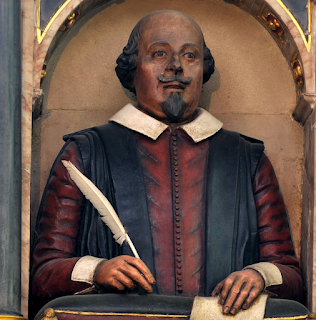
William Shakespeare the playwright's monument


 NB: A tidied up version of this blog has been posted on The Emigre, here.


Ever since I wrote an article for the Spectator, responding to Jodi Picoult’s novel, By Any Other Name, which suggests (somewhat surprisingly) that a woman called Emilia Lanier actually had a hand in the plays of William Shakespeare’s, I’ve found myself becoming more and more interested in the world of Shakespeare deniers. That a novelist with such a large following should fall prey to this kind of unevidenced theory is bad enough - we hardly know who Emilia Lanier was, let alone that she ever even met Shakespeare; that the London Library should host Elizabeth Winkler and Derek Jacobi, two people who believe that Shakespeare wasn’t Shakespeare, was somehow worse. (For the purposes of this article I am going to use the spelling Shakespeare, which has been ably demonstrated by David Kathman as having been the most common spelling of the name at Will's time, and also has the benefit of being the one everyone recognises.)

One of the things that has been bothering me is: why? It seems to have become an emotional issue, unlike any other. Why do people think this way? And why is it only William Shakespeare? Why not any other poet, playwright or novelist? We have very little evidence about Geoffrey Chaucer, for example, and hardly any manuscripts that bear his name. For some people like Thomas Malory, there are a couple of potential candidates to be the writer of the Morte Darthur: yet no sinister conspiracy is mooted. Dipping a toe into this world has led me into some quite strange places: one person announced, in a piece on The Sceptic's website, that I couldn't possibly know as much about Shakespeare as the late Shakespeare denier Alexander Waugh (whom, incidentally, I knew and admired), since he was the son and grandson of two writers. (If we're going to play that fairly arbitrary game: Alexander Waugh studied music at university; I read Classics and English, and my family is highly literary, with writers, academics, priests and scholars going back generations: I have one of my gt-gt-gt grandfather's copies of Shakespeare, as well as my grandfather's. I also happen to have gone to Evelyn Waugh's school, Lancing, and I worked for Literary Review, where Auberon Waugh had been editor. Enough Waugh connections for you? The Sceptic writer, it seems, is making the same argument as Shakespeare deniers do about Shakespeare.)

Let's start with the basics. Most  Shakespeare denialists begin with the premise that a glover’s son from Stratford upon Avon “couldn’t possibly” have had the education or knowledge to write such a glitteringly wonderful series of plays: it must have been an aristocrat. Never mind the snobbery involved, or the fact that large parts of his plays are not about aristocrats (Merry Wives of Windsor, anyone?) this also ignores several things. Firstly, the background of literally every single other Elizabethan and Jacobean playwright. Ben Jonson’s stepfather was a bricklayer; John Webster’s father a carriage maker; Christopher Marlowe’s a shoemaker, and so on. Playwrighting was clearly an occupation of the middle classes; Francis Beaumont and Cyril Tourneur are the only ones with much pretence to gentility by blood; John Fletcher came from a family of clerics.

Secondly, by insisting that only an aristocrat with knowledge of the court could have written Hamlet, it discounts several things: both imaginative responses, and the fact that by relying on such an argument, you're also saying that an aristocrat couldn't have written, say, the schoolmaster scenes in The Two Noble Kinsmen. (This is also leaving aside the facts that Shakespeare didn't actually write very accurately about court scenes, or the fact that he did have some experience of court life, as he was a player for King James. These two facts can exist in tandem: he wasn't directly copying what he saw.) This argument  links education with imagination, as if only a certain level of education would allow a writer to be inventive, and that invention would be limited to a direct copy of the experience. And yet it’s also demonstrably easy to demonstrate that Will Shakespeare, as the son of a civic worthy - as John Shakespeare was, without a shadow of doubt - would have had the same grammar school education as every other boy in the country. We know what was on the syllabus; we know what he would have read: we can match the reading to the plays; we know that Shakespeare didn't go to university, unlike Christopher Marlowe, but like John Webster.

Even if you start from Shakespeare’s plays and work back, the evidence that he was educated is there: he had about the level of Classical knowledge that you would expect someone to have who went to a grammar school; but he’s not quite as self-consciously intellectual as, say, Marlowe. All it takes is reading the plays side by side; but few in the game seem to want to do this. 

 Deniers also seem unable to countenance that there was a very busy literary world in the Elizabethan / Jacobean period: you could buy books from the market, you could borrow them, you could lend them. We also know that Shakespeare visited Oxford, where he undoubtedly would have encountered a stimulating intellectual environment, and might well have had access to the Bodleian. (But deniers don't like the idea of an autodidact.) One of Shakespeare's Stratford friends was even a bookseller in London.

It’s clear from other Jacobean playwrights that they all had access to a number of texts, some very erudite indeed - Thomas Dekker, for example, who after his release from prison was at work on numerous plays, which required a number of different sources. When I posited this evidence, the answer I was given by a denier was that Dekker must have been a front too. It seems that, like a packet of Pringles, once you pop, you can’t stop. The idea that any working playwright was a front for someone else is, well, there’s no other word for it: ridiculous. 

Some say that it wasn’t done for aristocrats to put their name on artistic work: which would have been news to Sir Philip Sidney, and also to the Earl of Oxford himself, who was quite happily mentioned by his contemporary Francis Meres as a good writer of comedy. This assumption is simply that: an assumption, with no historical or documentary basis, which doesn't stand up in the slightest. And yet this doesn’t seem to bother the deniers either.

To return to  what we know of the life. John Shakespeare was heavily involved in  the town of Stratford-upon-Avon, as we know from records; he would have had a hand in the running of the grammar school there. In fact, once you situate Will Shakespeare within his time, it becomes almost impossible to believe that he wasn’t the poet and playwright. He had a father, mother, siblings, children: one of his grandsons was given the first name Shakespeare, as was another Hart relative; his brother, Edmund, came up to London to become a player. 

If you had a famous playwright in the family, you’d probably want to name your child after him, especially if the surname was in danger of dying out, as Shakespeare had no male line descendents; if you had an older brother who’d spectacularly made it in the theatre world, you’d probably want to follow him into it. (Note that I say “probably” here, because of course I have no direct evidence for the motivations behind these events: but one of the things that Shakespeare deniers do is ignore probability based on evidence, in favour of wild surmise.) I can say this with a degree of certainty, because that is where the evidence points. Shakespeare, like anyone else, existed within a complex web of business and family relationships.  If you are positing that Shakespeare wasn't Shakespeare, then that's a whole lot of people who have to be  in the know: and that's a whole lot of evidence, also, that has mysteriously vanished.

What’s also interesting is that as we discover more about authorial co-operation in the Bankside theatres, the case for a mysterious original hand entirely evaporates. You could - just about, if you had never read the plays thoughtfully, or looked at the documentary evidence - believe that one person wrote the plays in secret, and then had them delivered over decades to a theatre where Shakespeare pretended they were his. (Over decades? Give me a break. Once or twice would have been hard enough to manage.) But once we understand that Shakespeare worked with others - with the actors, for whom he wrote specific parts; with his fellows in his playing company, with whom he made business decisions about what plays to put on (such as King Lear, which was a version of a previous hit, King Leir); and with other playwrights, then it becomes much harder to believe in this hidden hand. 

Shakespeare would have been working in the same room as his collaborators: it’s difficult to believe that the playwrights with whom he was working on a close, daily basis, were all somehow privy to a mysterious secret that Shakespeare wasn’t who he said he was. If he couldn't write, why was he in the theatre in the first place? What happened when they needed a piece or a scene rewritten quickly? These questions never seem to bother deniers.

These things should kill  off any doubt stone dead. But somehow, they don't.  The deniers bring up the “documentary gap”, whilst oblivious to the glaring documentary gap in their own theories. For this theory I blame Mark Twain, of whom I was quite fond until I realised how damaging he had been: he wondered why Shakespeare had not left any letters behind. Unfortunately, Mark Twain didn’t know anything about archives or Elizabethan history, or how documents survive through time. We hardly have any letters from any playwrights. There are "documentary gaps" for every single playwright of the period.

In truth, there isn't much of a "documentary gap" at all when it comes to Shakespare, and we have a lot of documents, alongside other evidence, that demonstrate beyond any reasonable doubt that Shakespeare was exactly who everyone said he was. What we don't have is any documents that suggest a conspiracy, and I'll come to that later.

Will Shakespeare's father’s life is exceptionally well documented, and we know that dozens of players visited Stratford in Will’s childhood. We have his will, dictated on his deathbed (hence the shaky signatures, which Lena Cowen Orlin suggests were because he was writing leaning on a cushion); we have the evidence  his friends and fellows in his acting company, and of people who saw the plays and talked about them. We have a document showing he was given red cloth (as a player) by King James. We have a letter to him from a relative. We have the grant of arms that he petitioned for his father. We have his monument in the Stratford church, and we have the reactions to his death from his friends and fellows (whom he left money with which to buy remembrance rings). We have much more, which I will not enumerate here, but which is all available to look at in the Folger Library.

And that’s even setting aside the evidence that stares us in the face - the fact that it’s William Shakespeare's name on the poems and the plays, and not anybody else's. There is no reason to posit that Will Shakespeare was lying, that the printers and editors were lying, or that the Stationers’ Guild were lying when they wrote down his name in their register, just as there is no reason to believe that they were lying about Webster, Dekker or Middleton.

So let's entertain the idea, for a minute, that there was in fact a conspiracy to hide the "real" identity of the works of William Shakespeare, even if we can't think of a plausible reason for this. Think of the number of people who would have to be involved in it: his family; his landlady; his colleagues; the players in the companies; his fellow playwrights; the people he knew in Stratford and London. That's just on his side.

If there had been an aristocrat involved, there would have been liveried servants passing to and fro all the time, who would have been noted. And every single one of these people would have had a very good and concrete reason for letting this apparent secret slip. Had there been a conspiracy, there would have been evidence of it, since people involved in conspiracies tended to write letters to each other (think of the letter in the Gunpowder Plot that was mercifully discovered), and such a letter would have had immense value and thus, on the balance of probability, given its apparently earth-shaking contents, would have been kept, whereas a letter from Will Shakespeare about his tithe lands would have gone the way of all other letters. Given the cutthroat relationships of the theatres with each other, it would have been golddust for a rival company to uncover that Shakespeare was a front.  In other words, had there been such a conspiracy, we would have known by now. But all that happens is that more research and more scholarship links William Shakespeare, the boy born in Stratford, with the plays and poems that bear his name.

Shakespeare deniers refuse to believe entirely probable things about William Shakespeare, such as that he went to grammar school, or that he was able to conduct business transactions at the same time as writing plays; but they insist that their preferred candidates must have done impossible things in order for their theories to stand up. Perhaps the most outrageous of these is the Earl of Oxford, who died in 1604, before Shakespeare had written several of his final plays, including King Lear. The response to this, I was amazed to discover, is that the Earl of Oxford must have written King Lear before he died, along with all the other subsequent manuscripts, and he left it lying around to be performed after his death.

So once more: what’s more probable? That a time travelling Earl, whose letters we do have, and whose upbringing, accent, handwriting, and vocabulary range were entirely different from Shakespeare’s, wrote King Lear several years before it was put on, even despite the play’s many direct contemporary relevances to 1609? Or that Will Shakespeare, the well known playwright, actor and poet, responding to demands from the theatre and his fellows, saw a good thing in King Leir, noted the relevance of it to the recent union of Scotland and England, and added his own particular brand of tragic art to the ending? 

In truth, to return to my original question: I wonder why would you take away a man’s singular and well-attested artistic and dramatic achievement, and replace it with someone else’s, on the basis of nothing more than assumptions which, when examined, fall away like thistledown? 

I wish I knew the answer to that question, but I fear it will never come. In the meantime, I’m certainly going to continue to work to promote documentary evidence, historical accuracy, and rigorous scholarship in everything that has to do with the  Stratford playwright, William Shakespeare.

Those wishing to discover more: read 

The Private Life of William Shakespeare by Lena Cowen Orlin

Contested Will by James Shapiro


Monday, 19 May 2014

King Lear for PORT magazine

Afternoon all: I've written a little piece on why I love King Lear, for PORT magazine. You can read it here.

Friday, 12 April 2013

James McAvoy in Macbeth: review

Macbeth is a bloody play, there's no doubt about that. From the opening speeches - "What bloody man is that?" - and the captain's gory image of his "gashes" crying for help, all the way through to the usurping, murderous King's end, it's not one that lets violence happen offstage.

But it is also a play that contains poetry, and stillness, and contrast; and in this, Jamie Lloyd's relentless production at Trafalgar Studios was a touch lacking.

The action took place in a claustrophobic, bare, post-apocalyptic setting in the round, with the actors frequently breaking out of their space into the audience - James McAvoy's furious Macbeth entered rushing on his knees, whilst the porter addressed a puzzled playgoer. The setting played on the "tale told by an idiot / full of sound and fury / signifying nothing," as we were treated to something almost Beckettian in its starkness; and yet the players were constantly rocketing about the stage, spitting and screaming as if they were always on the point of death.

Everybody was covered in blood, most of the time, which (as my companion, who hadn't seen the play before) didn't do much to help identify who was who. Because of the constant barrage of decibels and speed of the speeches, the sense and beauty of the poetry was indeed reduced to sound and fury.

The production borrowed tropes from horror films: masked murderers, a zombie-like Banquo's ghost, severed heads and trapdoors (which sometimes tipped into absurdity.) And that is a problem of genre, because Macbeth is not a horror film, and reducing it to a simple matter of gore piled upon gore robs it of any sense of grandeur.

For we never got a sense that Macbeth thought about his actions. James McAvoy is an engaging actor, and clearly enjoyed strutting about the stage, packing the performance (quite literally) with some guts; but he was a psychopathic Macbeth, one for whom violence is all, not one who equivocated. Similarly, Lady Macbeth was so insane from the beginning that when she did go nuts you hardly noticed. The text was cut up too: the shock of the prophecy about Dunsinane wood was immediately spoiled by a cut in to the English soldiers being ordered to pick up trees.

Mark Quartley's Malcolm was a welcome point of calm(ish); and Jamie Ballard's Macduff produced the most emotional moment in the play, with Shakespeare's devastating line - "All my pretty chickens?" He showed a father's sheer grief and terror at the death of his family beautifully. If only he hadn't spoiled it all by screaming his revenge.

The largely young audience clearly enjoyed this Macbeth, and I suppose if enough teenagers go away thinking, well Shakespeare isn't that bad after all, then that must be positive. But I can't help wishing that the matter of the play had been allowed to breathe a little more, that the poetry had been allowed to sing. Macbeth himself becomes a poet, after all: "Light thickens / And the crow makes wing to the rocky wood." Yes, this is a play of seething terror and blackness: but blackness, in order to function properly, needs light.


Saturday, 8 October 2011

Literary Review redesigned; review of Carol Birch's Jamrach's Menagerie

The redesigned cover
    Jubilation and joy all round, as Literary Review (where I am a Contributing Editor) launches its redesign with the October issue. It's a simple, elegant style that is both striking and subdued. The reviews look inviting and uncluttered, practically leaping off the page in their eagerness to be read. It is a joy to behold. Of course the quality of the contributors remains excellent - in this issue we have Anne Somerset on Francis Walsingham; John Sutherland on Charles Dickens; Sam Leith on J G Ballard; Katherine Duncan-Jones on Shakespeare; John Gray on humanity, and many more, including a fabulous essay on puppets by Steven Connor, and reviews of Michel Houellebecq, Ruth Prawer Jhabvala, Barry Unsworth, Jeffrey Eugenides, Esi Edugyan, and my own review of Carol Birch's Booker-shortlisted Jamrach's Menagerie, which I believe a strong favourite to win the gong (although whether this is a list that one should be proud of being on is another matter). I think it's really now between Barnes and Birch - at least, it ought to be. You can't read the review online, so you must go out NOW and get your hands on the extremely smart new issue of the magazine. You'll enjoy it, I promise.

Tuesday, 4 October 2011

Bertie Wooster revisited: Poetry Recital Prize at Thomas' Battersea

Carol Ann Duffy: First past the (last) post
A stonkingly early start today, as I reprised my Bertie Woosterish role (you may remember last time). I was honoured to be giving away the prize at Thomas' Battersea for their Poetry Recital Competition. I was astonished by the quality of the poems chosen and by the way they were delivered. It really gave me heart to think that children at that age can enjoy, understand and delight in reciting such complex and interesting poems. It brought back memories of my own poetry recital competition - I think I slightly optimistically did Byron's The Isles of Greece (I can still remember the first few lines...)

We had brilliantly sinister renderings of Crow’s Fall by Ted Hughes and Mushrooms by Sylvia Plath; an intelligent declamation of Hughes' The Thought Fox too. There was a galloping recital of an old favourite, Tennyson's Charge of the Light Brigade, and a joyous rendering of Daffodils by William Wordsworth. Humour was brought with The Naming of Cats by T S Eliot; poignancy with A Little By Lost by William Blake, and humour and poignancy together with William Shakespeare's All the World's a Stage. The winner, though, was current poet laureate Carol Ann Duffy's Last Post, which was delivered with excellent enunciation and a real sense of the tragedy of war.

Many congratulations to all who took part - it was a sterling collection of candidates. 


Sunday, 20 February 2011

Twelfth Night by William Shakespeare, dir. Peter Hall: review


Twelfth Night has always been one of my favourite Shakespeare plays (and not least because, at the risk of sounding like Polonius, I once played Malvolio...). It inhabits a territory that points towards the weird, late romances (which I favour over the comedies): a shipwreck, lost children, revelations. It is as full of wonder as any of the romances. It's also supremely well-knit, spare and tight, each word doing the job of three or four, its verbal dexterity and shot-silk quality embodied in the words of Feste.

The staging of Sir Peter Hall's production at the National Theatre was also spare. Viola (played by a charmingly gawky Rebecca Hall) stood at the beginning, bereft of everything she has known, her back towards the man who will help her. Orsino's (Martin Csokas) luxurious court was hinted at by three or four cushions (Orsino himself looked like a cushion, wearing a brilliantly long dressing gown of the type which I wish they still made. Barry Lyndon wears one in the Kubrick film, too.) The bare stage focused attention on the actors.

On the aristocratic side, Orsino was debauched, world-weary, commanding his group of courtiers with a languid finger. By contrast, Olivia (Amanda Drew), mourning her brother, was controlled and clearly able to run her household. It struck me that perhaps Olivia senses something missing in Viola - another lost brother - which might aid her infatuation. Drew was almost matronly, which belied her passion; my only difficulty was that one of her best lines ('lips - indifferent red') was swallowed. Sebastian (Ben Mansfield) was a fine, swashbuckling type, although with a slight femininity which maybe draws the captain to him, and helps us to understand the confusion between brother and sister.

Downstairs, Sir Toby Belch was played with malevolent sottishness by Simon Callow. This production really highlighted the cruelty of the trick they play on Malvolio (Simon Paisley Day) - played as a smooth-talking, smooth-dressing major-domo. The imprisonment scene had Malvolio in a tiny cage, blindfolded; with Feste (David Ryall) prancing around him and some sinister violin shrieking, the effect was positively hellish. Sir Andrew Aguecheek was absolutely marvellous, I thought. His foppishness and vanity were given an amiable touch, and Charles Edwards' face provoked many of the biggest laughs. When Malvolio stormed in and shouted 'do you make an alehouse of my lady's?' he nodded fervently as if he were a schoolboy who'd been caught by the headmaster.

Twelfth Night
is a play with no pat ending. Malvolio's last line, 'I'll be revenged - on the whole pack of you!' resonated loudly, and pointed towards the ambiguity of the solution to everyone's problems. Only Viola gets her true love; Olivia makes do with a copy, whilst Orsino's decision is based on practicality.

And Feste - when I first saw him I thought they'd made a terrible mistake. He was old, shrivelled. But then as the play went on I realised what a masterstroke it was. To have him singing 'youth's a stuff will not endure' gains extra poignancy. Feste's wildly wisecracking wit turns everything on its head: the fool is no fool, and Ryall's wizened old man showed in bold colours quite how full of wisdom he is. He sang in a slightly-out of tune warble (though trying to get the audience to join in at the end was not a good idea, I thought.)

It was a stately production, perhaps a little lacking in energy, but that added to its sense of elegy. 'Come Away Death', let's not forget, is one of the songs in it; and the Fool's song is repeated in King Lear.

I'll never forget my school production of Twelfth Night. One of the boys in my year, Will Ings, had composed a tune for 'Come Away...' It was haunting, and beautifully effective, and I wish I had a recording. It surfaced in my mind towards the end, and I was nearly brought to tears.

[I still harbour a deep love of the film version with Helena Bonham-Carter.]


Tuesday, 12 October 2010

The Stray Sod Country by Patrick McCabe: review


Here too is a link to my review in The Daily Telegraph, of Patrick McCabe's new novel, The Stray Sod Country
. It reminded me, in a weird, intertextual way, of Browning's 'Childe Roland to the Dark Tower Came': that sense of being in a place unknown, heading to a destination equally mysterious. In a way, I suppose, James A Reilly, a maddened teacher in the novel, could be a type of Poor Tom in King Lear, or even of Lear himself: raving and alone on the blasted heath. Click HERE