 |
| Helen McCrory as Medea |

Novelist and Reviewer: Author: The Other Book, The Liberators. The Darkening Path Trilogy: The Broken King, vol. 1; The King's Shadow, vol. 2, and The King's Revenge, vol. 3. The Double Axe, a retelling of the Minotaur story, and The Arrow of Apollo. How To Teach Classics to Your Dog published October 2020. Wildlord, publishing October 2021.
Showing posts with label Euripides. Show all posts
Showing posts with label Euripides. Show all posts
Wednesday, 23 July 2014
Medea at the National Theatre: review for PORT

Tuesday, 10 July 2012
From the Book Mountain: City of the Sharp-Nosed Fish by Peter Parsons: Greek Lives in Roman Egypt
A while ago I reported the problem of "book lag", something which everyone whose professional duty it is to read books suffers from (and, I imagine, a lot of people whose duty it isn't). This means that perfectly interesting and enjoyable books get forgotten about; you get half way through them before, suddenly you are called upon to review three 900 page novels by the day after yesterday, or similar. Inevitably, the books on my Book Mountain (rapidly becoming a Book Himalayas) turn out to be worth it. One such was Gardner Botsford's A Life of Privilege, Mostly, which memorably featured a tiger-skinned lady chasing its unsuspecting hero with a whip.
This time it's a star turn for Peter Parson's City of the Sharp-Nosed Fish: Greek Lives in Roman Egypt (Weidenfeld & Nicolson, 2007). This charming, entertaining and informative book is not only easy to read, it also delights with its clear-sighted analysis of the papyrus fragments found at the site of the Egyptian city of Oxyrhyncos. Here, in the early twentieth century, the archaeologists Grenfell and Hunt stumbled upon a classicist's dream - mounds and mounds of intact papyroi.
A few of them gave up texts of Homer; there was a lost play of Euripides, Hypsipyle, (which it is thought concerns the cursing of a group of women by Aphrodite for neglecting her shrine; her curse was to give them all extreme body odour. Perhaps that's why it was lost.) There were songs of Sappho (who features in a Ronald Firbank novel, Vainglory, in which a professor reads out, proudly, the fragment to assembled high society: "Could not (he wagged a finger) Could not, for the fury of her feet!") and other Greek lyricists. But most were prosaic, and as such add a huge amount to our knowledge and understanding of life at the height of the Roman Empire, just before Christianity.
There are many, shall we say, odoriferous anecdotes, but my favourite is this: Kallirhoe writes to a friend: "I make obeisance on your behalf every day before the Lord God Serapis. From the day you left we miss your turds, wishing to see you." It seems that those Egyptians had slightly different priorities. Then there's a "joke billet doux": "Apion and Epimas say to their very dear Epaphroditos: 'If you let us bugger you and it's OK with you, we shall stop thrashing you - if you let us bugger you.' Keep well! Keep well!'" As Obelix might say: "These Egyptians are crazy."
Spicy and engaging, Peter Parsons makes a knowing Hermes in this, his guide to a world that we can build up from the tiniest of particles into a whole, bustling, human universe.
This time it's a star turn for Peter Parson's City of the Sharp-Nosed Fish: Greek Lives in Roman Egypt (Weidenfeld & Nicolson, 2007). This charming, entertaining and informative book is not only easy to read, it also delights with its clear-sighted analysis of the papyrus fragments found at the site of the Egyptian city of Oxyrhyncos. Here, in the early twentieth century, the archaeologists Grenfell and Hunt stumbled upon a classicist's dream - mounds and mounds of intact papyroi.
 |
| Obelix: "These Egyptians are crazy!" |
There are many, shall we say, odoriferous anecdotes, but my favourite is this: Kallirhoe writes to a friend: "I make obeisance on your behalf every day before the Lord God Serapis. From the day you left we miss your turds, wishing to see you." It seems that those Egyptians had slightly different priorities. Then there's a "joke billet doux": "Apion and Epimas say to their very dear Epaphroditos: 'If you let us bugger you and it's OK with you, we shall stop thrashing you - if you let us bugger you.' Keep well! Keep well!'" As Obelix might say: "These Egyptians are crazy."
Spicy and engaging, Peter Parsons makes a knowing Hermes in this, his guide to a world that we can build up from the tiniest of particles into a whole, bustling, human universe.
Saturday, 26 March 2011
The Liberators by Philip Womack, read by Tim Bruce: review

legousi d'hos tis eiseleluthe zenos
goes epodos Ludias apo chtonos
zanthoisi bostruxoisin euosmon komen
An outsider has come, they say,
Howling out enchantments: a sorceror, from Lydia.
His hair smells sweet, his golden curls like lightning. (The Bacchae, Euripides, lines 233-235, translation by PW.)
Unlocking the inspiration for any book is an impossible task: there are usually several strands, some of which the author may not be aware of until even years after he or she has finished a book. But one cornerstone of The Liberators was always The Bacchae. In it, Pentheus refuses to believe in the avatar of Bacchus (pictured, looking as if butter wouldn't melt in his mouth, by Simeon Solomon), and meets a bloody death, torn apart by his own mother. Thus was born the idea of a positive force misused for evil.
The dramatic origins of The Liberators were brought to the fore of my mind as I listened to Tim Bruce reading it (six CDs, six days). The recording opens with my translation of the lines from the play which describe the arrival of Bacchus - a stranger with golden hair who promises enchantment. (I was very glad that they chose to do this; not least because one of the reasons I wrote The Liberators was to bring Ancient Greek to children in a digestible form).
One listens to an audiobook as if one were a child: entirely. Thus the scenes that I wrote appeared in my mind in glorious detail. In fact, I think I am going to hire somebody to read out my manuscripts to me as it makes one alive to nuance in a way that is impossible when you are reading it on the page, or even (as I sometimes do) reading it out loud.
Tim Bruce's voice is rich and mellow, capable of ranging from a very haughty Olivia Rocksavage, through the looser tones of the teenagers, to Strawbones' fake cockney, and Julius' harsh, barbaric accent. Strawbones shifts nicely from charismatic to monstrous. One thing that was very effective was the way that Bruce made the ecstatic cry of the Liberators sound. In his hands (as it were) it was a lilting, quasi-religious song, with two long, descending tones. I'd always imagined it as a fiercer, more brutal sound, but it was chillingly good.
Bruce also conveyed brilliantly changes of pace; Ivo's meeting with Julius in his flat was terrifying. It is also rather wonderful to hear the faint crackle of the recording, as if the static makes it authoritative and real.
Hearing the book has also made me notice things I hadn't before; for instance, Ivo's breaking of Strawbones' painting after he's destroyed the Liberators is a manifestation of rage that he should have controlled. There are still lessons to be learned; it's not all finished yet. But, as Ivo thinks as he approaches the end, 'there is a pattern in the world, there is a way into the future.' Listening to the book has been immensely rewarding and enriching; the syllables flowed over me warm and exhilarating. I hope that all who hear it will enjoy it too.
Sunday, 26 December 2010
Books of The Year: Day One

As a reviewer, I don't get to read as many classics as I would like, but I do try to keep at least one at a time going. This year, my most satisfying discovery was J G Farrell's 'Empire' Trilogy. Such meatiness of prose - if his books were meat, they would be enormous capons or possibly large legs of lamb with giant crunchy roast potatoes and really thick gravy. And bread sauce, of course. And they would bring a spirit lamp to your table to make your coffee afterwards. Now, where was I. Yes, I'm going to give my own personal books of the year, spread over five days. I had intended to write them in sonnet form - or at least in the form of 'The Hunting of the Snark' - but then I thought it would probably take too long.
On the first day of Christmas, my true love sent to me (or if she had sent these books to me, then she would definitely have been my true love) a whole load of classic works. Furies, fops, fiends and fripperies (and ladders): it's my top twelve old books of the year.
1. The Family Reunion by T S Eliot
It's like the worst and best Christmas ever all at once! And it's all in poetry! Amazing. Just watch out for the Eumenides, who happen to be hiding behind the curtain. Of course.
2. The Thirty Nine Steps by John Buchan
Oddly enough, I'd never read this at school, though everyone else had. I won't tell you what the Thirty Nine Steps are. You probably know. This is most definitely the most rambustiously exciting of all the Buchan thrillers.
3. Barry Lyndon by William Thackeray
If you've seen the wonderful film, (pictured here with Mr Lyndon about to blow smoke into his wife's face), then you'll be stunned at the novel - Barry Lyndon is here portrayed with the blackest of morals; even Lady Lyndon is frightful. It still makes me want to walk around in a frock coat and duel a lot, though. The first of many dubious heroes who have accompanied me this year.
4. The Black Sheep by Honore de Balzac
Intricate and thrilling tale of sibling rivalry - Philippe is as much of a monster as Barry Lyndon. Fortunately virtue prevails in the end, in the form of his artist brother Joseph.
5-7. Troubles by J G Farrell, The Siege of Krishnapur by J G Farrell, The Singapore Grip by J G Farrell
See above for the steakiness of these books. They create a world so entire that it occupies one's mind for days. Empire collapses; hypocrisies are exposed; absurdities pile up; and does anything change? We can only hope...
8. The Soul of Kindness by Elizabeth Taylor
A beautifully wrought study of loneliness and misdirected intentions. Taylor is brilliant at having her characters mooch about London not doing very much - and her writing is beautiful too.
9. Hippolytus by Euripides
Poor old Hippolytus doesn't really get much of a look in... It's such an alien concept, that to still feel the blade of the tragedy centuries later as keenly as ever is deeply thrilling. Watch out for that bull!
10. In Cold Blood by Truman Capote
No bulls, but more blades, and a human tragedy, this study of evil resonates loudly.
11. The Italian by Ann Radcliffe
Scary monks! Last minute reprieves! Underground vaults! Illicit marriages! Comedy servants! Nuns! There is absolutely nothing that you could want in a gothic novel that isn't in this stonkingly brilliant novel. There's even a moment to rival the end of The Empire Strikes Back. Yes, really.
12. The Red and the Black by Stendhal
The last of the dubious heroes, Julian Sorel is a carpenter's son who hacks his way up from a position as tutor to a provincial noble to the salon in Paris of the Marquis de la Mole and conquest of M Mole's daughter. The plot veers excitedly from farce - he's putting a ladder up against his lover's window! And then three pages later he's doing it again! - to tragedy, with a good dose of mordant satire in between.
Merry St Stephen's Day! I can't see anyone collecting wood from my window, but if you can, I'd invite them in for a mince pie - and a reading of T S Eliot.
Sunday, 5 December 2010
Ovid and Sophocles: They've Done it Again
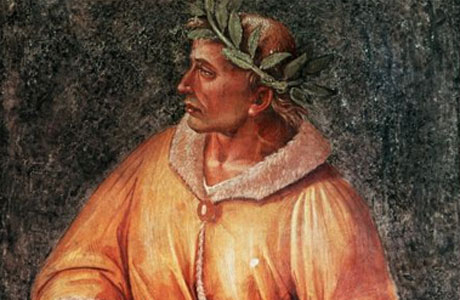
The weekend was spent buried deep in various texts, for various reasons; as I truffled through them I did come up with this:
'saepe pater dixit: 'studium quid inutile temptas?
Maeonides nullas ipse reliquit opes.'
Plus ça change. It's from Ovid, Tristia (4.10), and its translation is as follows:
'Often my father said, 'Why are you hacking away at that pointless fad?
Homer himself didn't leave behind any money.'
It's Ovid's father, telling him off for wanting to be a poet. Ovid's brother, of course, is a sparky lawyer. (Maeonides is a name often used for Homer as he was thought to have been a native of Maeonia, or Lydia as it was otherwise called.)
It is so marvellous to hear the voice of the father roaring out across the centuries as his useless son potters about with ink and papyrus instead of swotting up on legal precedents. More proof, if any is needed, of the 'relevance' of classical studies...
Also, what could be more beautiful than this, from Sophocles' Ajax?
'horo gar hemas ouden ontas allo plen
eidol' hosoiper zomen he kouphen skian'
Translated (poetically, in the Penguin translation) as
'Are we not all,
All living things, mere phantoms, shadows of nothing?'
Tuesday, 9 March 2010
Euripides Fragment 25
Stumbled across this fragment of Euripides:
pheu! pheu, palaios ainos hos kalos echei;
gerontes ouden esmen allo plen psophos
kai schem', oneiron d'herpomen mimemata,
vous d'ouk enestin, oiomestha d'eu phronein.
Translation:
Alas, alas, how the old tale holds truth;
we old men are nothing but noise
and appearance; we creep along, imitations of dreams,
there is nothing in our minds, though we think that we are sane.
Beautiful and sombre and quite heartbreaking.
pheu! pheu, palaios ainos hos kalos echei;
gerontes ouden esmen allo plen psophos
kai schem', oneiron d'herpomen mimemata,
vous d'ouk enestin, oiomestha d'eu phronein.
Translation:
Alas, alas, how the old tale holds truth;
we old men are nothing but noise
and appearance; we creep along, imitations of dreams,
there is nothing in our minds, though we think that we are sane.
Beautiful and sombre and quite heartbreaking.
Subscribe to:
Posts (Atom)